
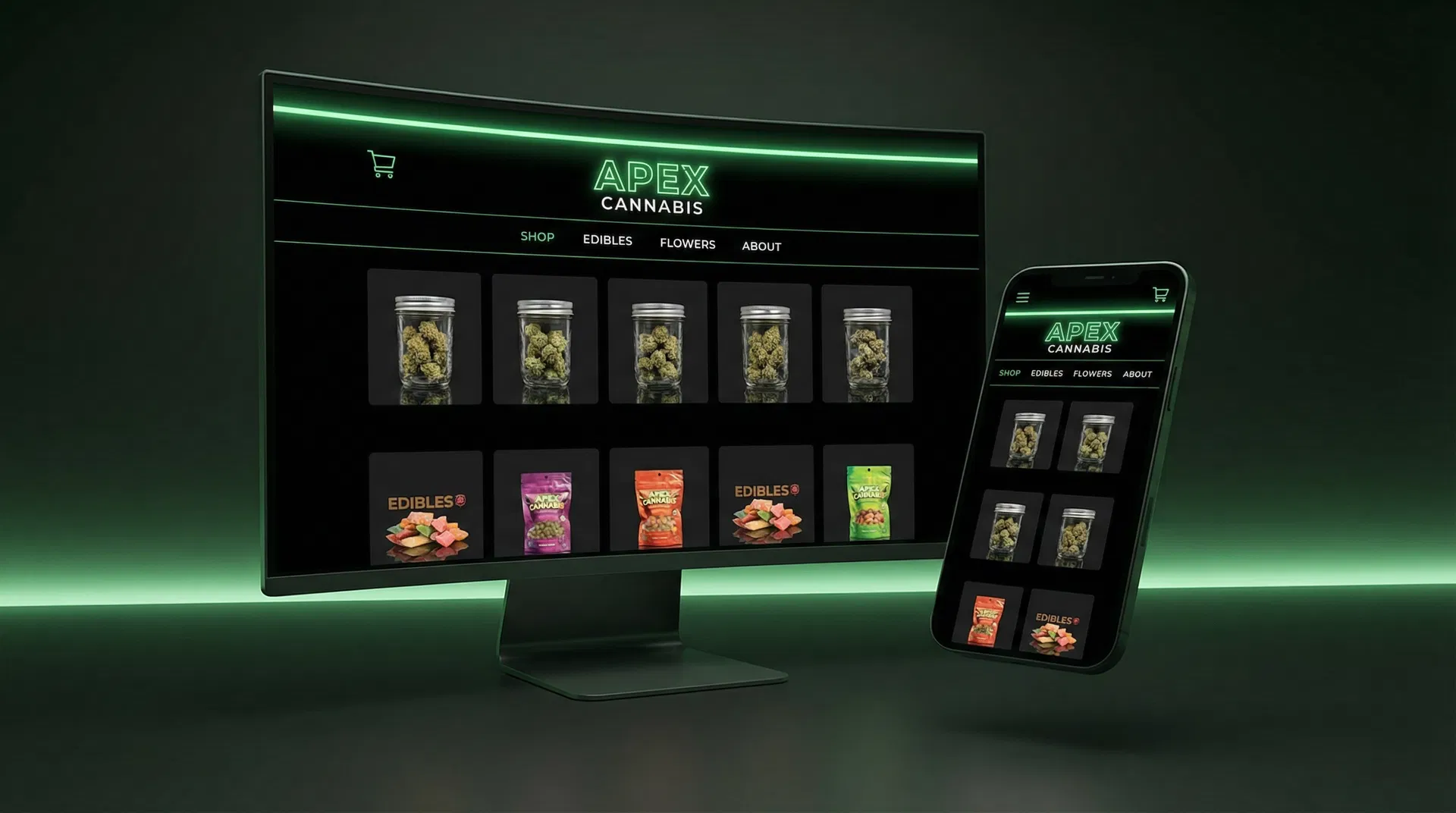
Cannabis Dispensary Website Design That Converts
Key Takeaways
- • Your dispensary website is not a digital brochure but a 24/7 salesperson that either converts visitors into customers or sends them straight to your competitor
- • Most dispensary websites fail basic usability tests and take so long to load on mobile that Google buries them before customers ever see them
- • The menu is the most important page on your site and if it loads through an uncrawlable iframe embed, your entire product catalog is invisible to search engines
- • Design decisions that look cool often destroy conversions because customers want speed, clarity, and an obvious path to your products, not animated backgrounds and artistic layouts
- • Every second your site takes to load costs you real money as visitors bounce to faster competitors selling the same flower, edibles, and concentrates you carry
Your Website Is Either Making You Money or Losing It
There is no neutral ground here. Every person who lands on your dispensary website either becomes a customer or does not. Either finds what they need and decides to visit your shop or clicks back to Google and tries somewhere else.
Your website is working for you or against you. Right now, while you read this, someone in your city is searching for weed near them. They clicked on your Google listing. They landed on your site. And within three seconds they made a judgment about whether to stay or leave.
Three seconds. That is how long you have to convince a potential customer that your dispensary is worth their time. That your flower is worth the drive. That your selection of edibles, vapes, concentrates, and pre-rolls is worth exploring instead of bouncing to the next result.
Most dispensary websites fail this test miserably. They load slowly. They look outdated. They bury the menu behind confusing navigation. They prioritize looking "cool" over actually converting visitors into customers walking through the door ready to spend money on bud.
If your website was built by whoever gave you the cheapest quote, or by your cousin who "knows web stuff," or by an agency that builds sites for dentists and lawyers and treated your dispensary like any other client, you are probably bleeding customers every single day. Understanding how to optimize your dispensary website for SEO is the first step to fixing this problem.
Speed Kills and Slow Speed Kills Your Revenue
Here is something most dispensary owners do not understand about how Google works: site speed is a ranking factor. A direct one. If your website takes five seconds to load while your competitor's loads in two, Google will rank them higher even if your content is better, your reviews are stronger, and your flower is more fire.
Google knows that slow websites frustrate users. Frustrated users bounce back to search results and try somewhere else. That behavior tells Google the slow site did not satisfy the search intent. So Google shows it to fewer people.
But ranking is only half the problem. The other half is what happens when someone actually lands on your slow site.
Studies show that 53% of mobile visitors abandon a site that takes longer than three seconds to load. Think about that. More than half of the people who click on your Google listing will leave before your homepage even finishes rendering if your site is slow.
They did not look at your menu. They did not see your hours. They did not check if you carry their favorite strain or have the edibles they want. They just left. Went to a competitor. Spent their money there instead.
And you never even knew they existed.
What Slows Down Dispensary Websites
The usual culprits are predictable:
- Uncompressed images: That beautiful photo of your flower taken with a professional camera might be 4MB. It should be 200KB. Every oversized image adds seconds to load time.
- Too many plugins: WordPress sites bloated with 30 plugins for features nobody uses. Each one adds code that has to load.
- Cheap hosting: The $5 per month hosting plan that seemed like a good deal is sharing server resources with hundreds of other sites. When traffic spikes, your site crawls.
- Embedded third-party scripts: Chat widgets, analytics tools, social media feeds, and menu embeds all add external requests that slow everything down.
- No caching: Your server rebuilds every page from scratch for every visitor instead of serving cached versions.
- No CDN: Visitors far from your server location wait longer for content to travel across the internet.
How to Fix Speed Issues
Run your homepage through Google PageSpeed Insights right now. Look at your mobile score. If it is below 50, you have serious problems. If it is below 70, you have work to do. Aim for 80 or higher.
The report tells you exactly what to fix. Compress images. Enable caching. Reduce server response time. Remove unused JavaScript. Follow the recommendations and watch your score climb.
If this sounds technical, that is because it is. You might need a developer to implement fixes properly. That investment pays for itself in customers who actually see your site instead of bouncing to competitors while your homepage struggles to load. Learn more about how long it takes to see marketing results when you fix these issues.
Mobile First Because That Is Where Your Customers Are
More than 60% of cannabis searches happen on mobile devices. People searching for dispensary near me while walking down the street. People checking if you are open before driving over. People looking at your menu while sitting in your parking lot deciding what to order.
If your website does not work perfectly on a phone, you are invisible to the majority of your potential customers.
Here is what a bad mobile experience looks like:
- Text so small you have to pinch and zoom to read it
- Buttons so close together you tap the wrong one
- Horizontal scrolling because the page does not fit the screen
- Images that take forever to load and shift the page around when they finally appear
- Menus that are impossible to navigate with a thumb
- Pop-ups that cover the entire screen and are impossible to close on mobile
If your site has any of these problems, customers are leaving. Not because your products are bad. Not because your prices are wrong. Because your website is frustrating to use and the competitor's site is not.
Testing Your Mobile Experience
Pull out your phone right now. Go to your website. Not the app if you have one. The actual website that customers find through Google.
Now try to find your menu. How many taps did it take? Can you read the product names without zooming? Can you see prices clearly? Can you filter by category to find flower, edibles, concentrates, vapes, or whatever you are looking for?
Try to find your hours and address. How long did that take? Is the phone number clickable so customers can call with one tap? Is the address linked to maps so they can get directions instantly?
Now hand your phone to someone who has never been to your site. Ask them to find your indica flower selection. Watch where they struggle. Watch what confuses them. That confusion is costing you customers every single day.
Your Menu Is Your Most Important Page and You Are Probably Hiding It From Google
The menu is why people come to your website. They want to see what you carry. What strains are in stock. What edibles you have. Whether you carry their favorite cartridge brand or have concentrates worth the drive.
Your menu should be the easiest page to find and the easiest page to use. Instead, most dispensary menus are a disaster.
The iFrame Problem
Many dispensaries use third-party menu providers like Dutchie, Jane, or iHeartJane. These platforms are convenient. They sync with your point of sale. They handle online ordering. They make inventory management easier.
But here is the problem: if your menu loads through an iframe embed, Google cannot crawl it.
An iframe is basically a window into another website displayed on your page. Google's crawlers see the iframe tag but cannot read the content inside it. That means your entire product catalog, every strain, every edible, every concentrate, every accessory, is invisible to search engines.
You could have 500 products in your menu. You could carry the most sought-after strains in your market. You could have every category of cannabis product a customer could want. None of it helps your SEO because Google does not know it exists. This is one of the common SEO mistakes cannabis dispensaries make.
Your competitors with custom-built menus or properly integrated menu systems have pages for their products that Google can read, index, and rank. They show up when customers search for specific strains or product types. You do not.
Solutions to the Menu Problem
The ideal solution is a menu that lives natively on your website with actual HTML pages for products and categories. This requires development work but gives you full control over SEO.
If you must use a third-party menu provider, check if they offer an API integration instead of an iframe. Some providers allow you to pull product data into your own pages, which Google can crawl.
At minimum, create content around your menu even if the menu itself is not crawlable. Category pages describing your flower selection, your edible options, your concentrate variety. These pages can rank for relevant searches and link to your menu.
Whatever you do, do not let your entire product catalog remain invisible to search engines. That is leaving money on the table every single day.
Design for Conversions Not for Awards
Here is a hard truth many dispensary owners do not want to hear: the website design you think looks cool might be destroying your conversions.
Animated backgrounds. Parallax scrolling. Full-screen video headers. Artistic layouts where the navigation is hidden behind a hamburger menu even on desktop. These design choices win awards and impress other designers. They do not convert visitors into customers.
Customers want three things from your website:
- Speed. Load fast or they leave.
- Clarity. Understand immediately what you sell and where you are located.
- Easy navigation. Find the menu, hours, and location without hunting.
Everything else is secondary. The fancy animations, the trendy design elements, the creative layouts that make your site look different from every other dispensary. If they slow down the page or make it harder to find basic information, they are hurting you.
What High Converting Dispensary Websites Have
- Clear navigation: Menu, Locations, About, Contact. Visible at all times. Not hidden behind icons or creative labels nobody understands.
- Prominent menu access: A button or link to the menu visible immediately without scrolling. Often in the header. Sometimes as a sticky element that follows as you scroll.
- Location and hours visible: On the homepage. Above the fold if possible. Customers checking if you are open should not have to hunt for this information.
- Click to call: Phone number as a clickable link on mobile. One tap to call. Not a number you have to memorize and type.
- Direction link: Address linked to Google Maps or Apple Maps. One tap to start navigation.
- Trust signals: Review ratings displayed. License information visible. Signs that you are a legitimate, established business.
- Fast loading images: Compressed and optimized. Looking good without killing load time.
Notice what is not on this list: videos that autoplay, animations that trigger on scroll, Instagram feeds that load hundreds of posts, chat widgets that pop up immediately, full-screen age verification modals that take ten seconds to load.
Every one of those elements might seem like a good idea. Every one of them slows your site and adds friction to the customer journey. Learn about marketing that drives real engagement without sacrificing performance.
The Age Gate Problem
Cannabis websites need age verification. That is not negotiable. But how you implement age verification can either be a minor speed bump or a brick wall that sends customers running.
The worst age gates:
- Take forever to load
- Require entering a full birthdate with dropdowns that are impossible to use on mobile
- Cover the entire screen with no indication what is behind them
- Reload the page after submission, making visitors wait again
- Use images or animations that add seconds to load time
Better age gates:
- Load instantly as part of the page, not as a separate element
- Require minimal interaction, ideally just clicking "Yes, I'm 21+"
- Use a cookie to remember the choice so returning visitors skip it
- Are lightweight with no unnecessary images or scripts
- Allow glimpses of the site behind them so visitors know they are in the right place
Your age gate is the first interaction every visitor has with your website. If it is slow and annoying, they are already frustrated before they see anything else. Start them off right with a fast, simple verification that gets out of the way. Make sure your age gate stays compliant with cannabis advertising regulations.
Content That Converts and Ranks
A beautiful, fast website with clear navigation still needs content. Pages that tell Google what you are about. Pages that answer customer questions. Pages that capture searches and convert visitors.
Homepage
Your homepage should immediately communicate what you are, where you are, and what makes you worth visiting. Not a giant image with no text. Not a video that takes ten seconds to load. Clear, scannable information.
Include your city and neighborhood in visible text. Mention the products you carry: flower, edibles, concentrates, vapes, pre-rolls, tinctures, topicals, accessories. Use actual words that match what customers search for.
Location Pages
If you have multiple locations, each one needs its own page. Even if you have one location, a dedicated location page with your address, hours, phone number, embedded map, and neighborhood information helps with local SEO.
Write unique content for each location. What neighborhoods do you serve? What landmarks are you near? What makes this particular shop worth visiting?
Category Pages
Even if your menu is not crawlable, create pages for major product categories. Your flower selection. Your edible options. Your concentrate variety. Your vape and cartridge brands.
These pages can rank for category searches like "dispensary with good edibles in [city]" or "where to buy concentrates in [neighborhood]." They guide customers to your menu and give Google content to index. This is part of a solid content strategy that boosts dispensary sales.
Blog Content
Educational content that answers customer questions and targets relevant searches. Not generic cannabis content that every website has. Local content. Product-specific content. Content that connects your dispensary to your market.
Best indica strains for sleep that we carry. Guide to edible dosing for beginners. How to choose the right vape cartridge. What makes live rosin different from live resin. Content that helps customers and establishes your expertise.
Technical SEO Foundations
Beyond speed and mobile experience, your website needs technical SEO basics in place or Google will struggle to understand and rank your pages.
Title Tags and Meta Descriptions
Every page needs a unique title tag under 60 characters that includes your target keyword. Every page needs a meta description under 160 characters that compels clicks from search results.
Your homepage title might be "[Dispensary Name] | Cannabis Dispensary in [City], [State]"
Your location page might be "[Dispensary Name] [Neighborhood] | Flower, Edibles & More"
Do not leave these blank. Do not duplicate them across pages. Do not let your website platform auto-generate them with template text.
Heading Structure
One H1 per page containing your primary keyword. H2s for major sections. H3s for subsections. A logical hierarchy that helps Google understand your content structure.
Do not skip heading levels. Do not use headings just for styling. Do not have multiple H1s on a single page.
Schema Markup
Local business schema tells Google exactly what your business is, where it is located, when it is open, and how to contact you. This structured data helps Google display rich results and understand your business better.
At minimum, implement LocalBusiness schema with your name, address, phone number, hours, and geo coordinates. Add Organization schema for your brand. Consider Product schema for your menu items if you have crawlable product pages.
XML Sitemap
An XML sitemap helps Google find and index all your pages. Submit it through Google Search Console. Keep it updated as you add new content. Monitor for crawl errors and fix them.
SSL Certificate
Your site must load on HTTPS with a valid SSL certificate. No exceptions. HTTP sites show security warnings in browsers and get penalized by Google. This is table stakes in 2024.
What Your Competitor's Website Does Better
Search for dispensary in your city right now. Look at the websites ranking above you. Study them. What do they do better?
Chances are:
- They load faster
- Their mobile experience is cleaner
- Their menu is easier to find and use
- Their content includes keywords you are not targeting
- Their technical foundation is more solid
You do not need to reinvent anything. You do not need the most creative design or the most innovative features. You need to match or beat your competitors on the basics. Speed. Mobile. Navigation. Content. Technical SEO.
When you match them on basics, you can win on other factors like reviews, citations, and content depth. But if your website is fundamentally worse than theirs, no amount of off-site SEO will overcome that handicap.
The Investment That Pays for Itself
Fixing your website is not cheap. A proper redesign with speed optimization, mobile-first development, SEO foundations, and custom menu integration might cost $10,000 to $30,000 depending on complexity.
That sounds like a lot until you do the math on what a broken website costs you.
If your slow, poorly designed site loses 10 potential customers per day who bounce before seeing your menu, and each customer would have spent an average of $50, that is $500 per day in lost revenue. $15,000 per month. $180,000 per year.
Suddenly that $20,000 website investment has a payback period measured in weeks, not years.
Every day you operate with a broken website is a day you are paying the tax of lost customers. Customers who found you but could not tolerate your site long enough to become buyers. Customers who went to competitors with better digital experiences.
You cannot see these lost customers. You do not know their names. You do not watch them bounce. But they are real, and they are costing you money every single day. Track the right marketing metrics to understand the true cost.
Start Fixing Today Not Next Quarter
You do not need a complete redesign to start improving. You can make progress today.
- Run PageSpeed Insights and identify your biggest speed issues
- Test your site on mobile and list every frustration
- Check if your menu is crawlable by searching site:yourdomain.com and seeing if product pages appear
- Verify your title tags and meta descriptions are unique and keyword-optimized
- Confirm your SSL certificate is active and your site loads on HTTPS
Each issue you fix removes friction. Each improvement makes customers more likely to stay, explore, and eventually walk through your door ready to buy flower, edibles, vapes, and everything else you sell.
Your competitors are not waiting for you to catch up. The shops ranking above you already have fast, functional, optimized websites converting visitors into customers. Every day you delay is another day they capture customers who should be yours.
The search results are not going to fix themselves. Your website is not going to magically get faster. The only question is whether you act now or keep paying the hidden tax of a site that drives customers away. Contact us for a free website assessment and see exactly where you are losing customers.
Frequently Asked Questions
How fast should a dispensary website load?
Under three seconds on mobile. Ideally under two seconds. Every second beyond that increases bounce rate significantly. Use Google PageSpeed Insights to test your current speed and identify issues. Aim for a mobile score of 70 or higher.
Does my dispensary website need a blog?
Yes, if you want to capture search traffic beyond just your business name. Blog content targeting product searches, local guides, and educational topics brings in customers actively researching before they buy. Without a blog, you are limited to ranking for branded and basic local searches.
Why is my dispensary menu not showing up in Google searches?
Your menu is probably loaded through an iframe embed from a third-party provider. Google cannot crawl iframe content. Consider API integration, custom menu development, or creating supplementary category pages with crawlable content that links to your menu.
How important is mobile optimization for dispensary websites?
Critical. Over 60% of cannabis searches happen on mobile devices. Google uses mobile-first indexing, meaning they evaluate the mobile version of your site for rankings. A poor mobile experience hurts both rankings and conversions.
Should I use a website builder like Wix or Squarespace for my dispensary?
Website builders can work for basic sites but often have limitations for speed optimization, custom functionality, and advanced SEO. If budget is tight, they are better than nothing. But serious dispensaries typically benefit from custom WordPress or headless CMS builds that offer more control.
How often should I update my dispensary website?
Core pages should be reviewed quarterly for accuracy and optimization opportunities. Blog content should be added regularly, ideally weekly or biweekly. Your menu should sync automatically with inventory. Any time business information changes, update the site immediately.