
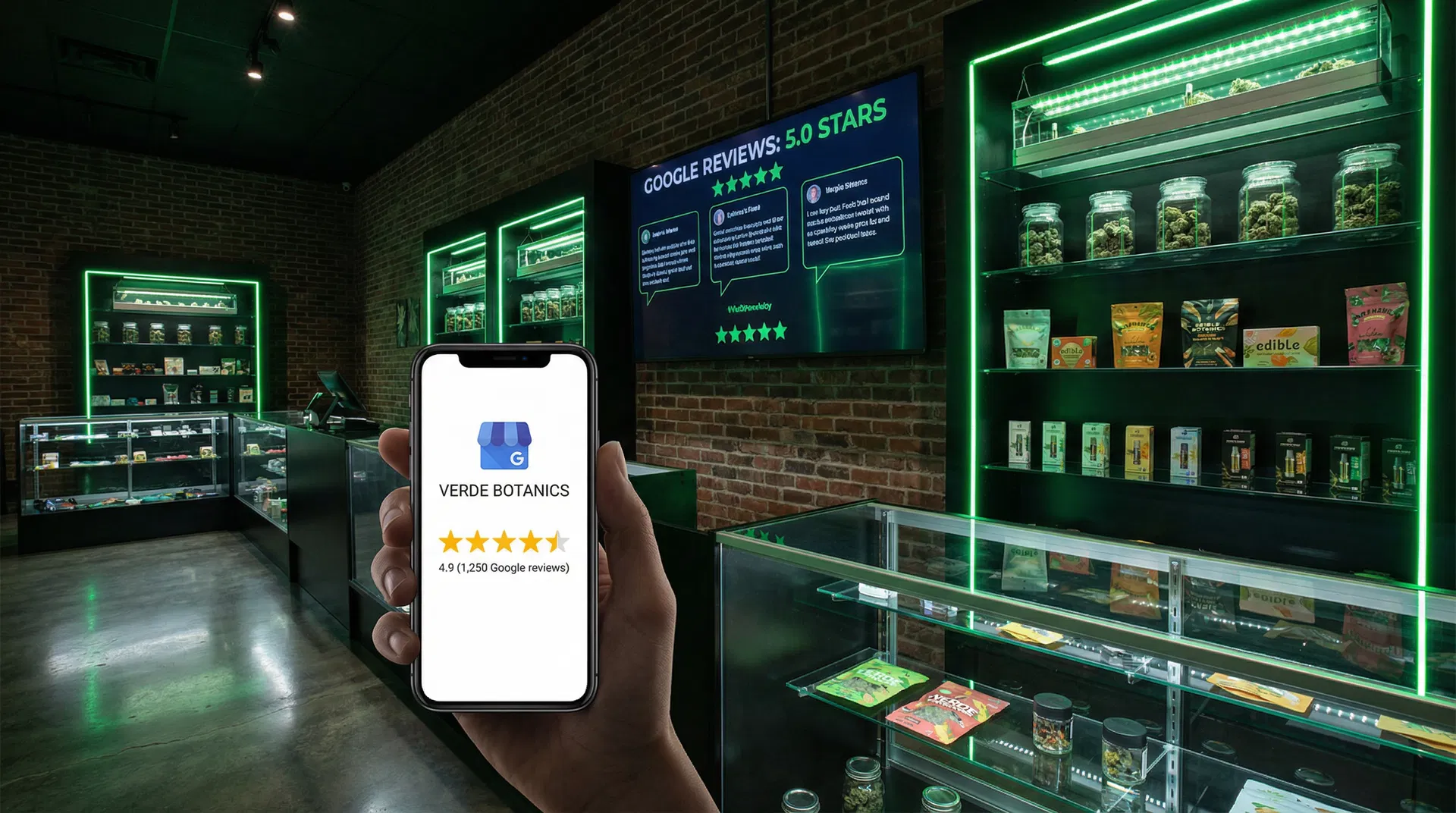
How to Get More Google Reviews for Your Dispensary
Key Takeaways
- Google reviews are not vanity metrics but a direct ranking factor that determines whether customers searching for flower, edibles, and vapes in your area find you or your competition
- The dispensary with 500 reviews and a 4.6 rating will outrank the dispensary with 50 reviews and a 4.9 rating almost every single time
- Most dispensaries have no system for generating reviews and rely on hope while competitors stack 20 to 30 new reviews every single week
- Review velocity matters as much as total count because Google wants to see that customers keep coming back and keep having experiences worth writing about
- Building a review generation machine requires training your team, creating multiple touchpoints, and tracking results like any other business metric that impacts revenue
The Math That Should Make You Sick
Pull up Google right now. Search for dispensary near me or weed shop in your city. Look at the three businesses in the Local Pack. Now look at their review counts.
Notice anything?
The shops at the top have hundreds of reviews. Sometimes over a thousand. They have fresh reviews from this week. They have responses to almost every single one. They have a steady stream of customers publicly vouching for their flower, their edibles, their budtenders, their selection of concentrates and cartridges and pre-rolls.
Now look at your profile. How many reviews do you have? When was the last one? How does your count compare to the shops outranking you?
If the gap makes you uncomfortable, good. That discomfort is the first step toward fixing it.
Here is the math that matters: a dispensary with 500 reviews and a 4.6 average rating will almost always outrank a dispensary with 50 reviews and a 4.9 average. Google interprets volume as trust. As popularity. As a track record of serving real customers who cared enough to write about their experience.
Your 50 reviews, no matter how glowing, signal a business that either just opened or does not prioritize customer feedback. Neither interpretation helps you rank.
Why Reviews Matter More for Dispensaries Than Almost Any Other Business
Cannabis dispensaries operate under restrictions that make traditional marketing nearly impossible. You cannot run Google Ads. Facebook bans your paid campaigns. Instagram shadowbans your content. The digital advertising channels that every other retail business uses to acquire customers are closed to you.
That leaves organic search. And in organic local search, reviews are one of the heaviest ranking factors Google considers.
Think about it from Google's perspective. When someone searches for a dispensary, Google wants to show them businesses that will satisfy their search intent. Businesses that will give them a good experience. Businesses that other real humans have validated as worth visiting.
How does Google determine which dispensaries deliver good experiences? Reviews. Lots of them. Recent ones. A pattern of satisfied customers over time.
Your product quality does not show up in Google's algorithm. Your budtenders' expertise does not register in search rankings. Your selection of premium flower, house-made edibles, top-shelf concentrates, and every smoking accessory from bongs to dab rigs to rolling papers does not matter if Google cannot see evidence that customers love you.
Reviews are that evidence. They are the social proof that tells Google and potential customers that your dispensary delivers.
The Difference Between Hoping and Systematizing
Here is what most dispensaries do about reviews: nothing. They set up their Google Business Profile when they opened. They got a handful of reviews from friends and family during the first few weeks. Maybe some organic reviews trickled in over the following months. And now they sit at 47 reviews while the competitor down the street has 380.
When asked about their review strategy, they say something like "we encourage customers to leave reviews" or "our service speaks for itself."
That is not a strategy. That is hope. And hope does not show up in the Local Pack.
The dispensaries stacking reviews every single week have systems. Actual documented processes that ensure every customer who walks out with an eighth of fire flower, a pack of gummies, or a fresh cartridge gets asked to leave a review. Multiple times. Through multiple channels.
These shops are not getting more reviews because their customers love them more. They are getting more reviews because they ask more often, more consistently, and through more touchpoints than you do.
The average happy customer does not think about leaving a review. They got what they wanted. They went home. They consumed their purchase. Leaving a review requires them to remember your business later, find your Google listing, and take time to write something.
Most people do not do this unprompted. Not because they did not enjoy the experience. Because leaving reviews is not something most people naturally do without a nudge.
Your job is to nudge. Systematically. Relentlessly. Until your review count matches or exceeds your top competitors.
Building Your Review Generation Machine
A review generation system has multiple components that work together. No single tactic will close the gap between your 50 reviews and your competitor's 500. You need a machine that captures opportunities at every stage of the customer journey.
Train Your Budtenders to Ask
Your budtenders interact with every single customer who buys from you. They recommend strains. They explain the difference between indica and sativa effects. They help customers choose between edibles and flower, between vape pens and pre-rolls, between the house concentrate and the premium live rosin.
That interaction is the perfect moment to plant the seed for a review.
After a positive exchange, after the customer thanks them for a great recommendation, your budtender should say something like: "I'm glad I could help. If you have a minute later, we'd really appreciate a Google review. It helps other customers find us."
Not pushy. Not desperate. Just a natural extension of good service.
Train every single budtender to do this. Role play it. Make it part of their standard closing interaction. Track who asks and who does not. The shops generating 30 reviews per week have teams that ask consistently. The shops stuck at 50 reviews have teams that forget.
Put QR Codes Everywhere
Make leaving a review as frictionless as possible. Create a QR code that links directly to your Google review page. Not your website. Not your Google Business Profile. The actual review submission screen.
Put that QR code everywhere:
- On the counter at checkout
- On receipts
- On exit signage near the door
- On table tents if you have a waiting area
- On business cards you hand out with purchases
- On stickers you put on bags
Every touchpoint is an opportunity. A customer waiting in line might scan the code out of boredom. A customer walking out might notice the sign and remember to leave a review. A customer unpacking their purchase at home might see the sticker and think "oh yeah, that budtender was great."
Reduce friction. Increase visibility. Make the path from satisfied customer to published review as short as possible.
Follow Up Digitally
If you collect customer phone numbers or emails through a loyalty program, delivery service, or opt-in list, you have a direct channel to request reviews.
Send a text 24 hours after purchase: "Thanks for stopping by [Dispensary Name] yesterday! If you enjoyed your visit, we'd appreciate a quick Google review: [link]. It helps us serve more customers like you."
Send an email with similar messaging. Include the direct link. Make it one tap or one click to leave a review.
Timing matters. Twenty four hours after purchase is the sweet spot. The experience is still fresh. They have probably sampled whatever they bought. They can speak to the quality of your flower, the accuracy of your edible dosing, the smoothness of your concentrates.
Do not spam them. One follow-up request per purchase is enough. But that one request, sent consistently to every customer in your database, adds up to a lot of reviews over time.
Respond to Every Review
This is not directly about generating new reviews, but it creates a flywheel effect that helps.
When you respond to every review, positive or negative, you signal to potential reviewers that their feedback will be seen and appreciated. People are more likely to leave reviews when they believe someone is actually reading them.
Responses also show Google that you are an engaged, active business. That engagement factors into how Google evaluates your profile against competitors who let reviews sit unanswered.
For positive reviews, thank them specifically. Mention something from their review. "Thanks for the kind words about our live resin selection. That Lemon Haze batch has been a favorite around here."
For negative reviews, respond professionally. Acknowledge their experience. Offer to make it right. Never get defensive or argumentative. Future customers will read these responses and judge how you handle problems.
Track and Set Goals
What gets measured gets managed. Set a weekly review goal based on closing the gap with your competitors.
If your top competitor has 400 reviews and you have 100, that is a 300 review gap. At 10 new reviews per week, you close that gap in 30 weeks assuming they stop generating reviews entirely, which they will not. So you need to aim higher. Maybe 20 per week. Maybe 30.
Track your progress weekly. Celebrate wins. Identify what is working and double down. If QR codes are generating more reviews than budtender asks, put more QR codes in more places. If text follow-ups are crushing it, make sure every customer is opting into your list.
Treat review generation like any other key performance indicator. Because it is. It directly impacts your visibility, which directly impacts your revenue.
Handling the Review Velocity Factor
Total review count matters. But velocity matters too. Google pays attention to how recently reviews were posted. A dispensary with 400 reviews but no new ones in the past three months looks different than a dispensary with 300 reviews and 20 new ones this week.
Velocity signals that customers keep coming back. Keep having experiences. Keep engaging with your business. It tells Google that your dispensary is currently relevant, not just historically reviewed.
This is why one-time review pushes do not work long term. You cannot blast your customer list once, collect 50 reviews, and then coast. Your competitors are generating reviews every single week. If you stop, they pull ahead. If you maintain velocity, you stay competitive.
Build the system. Run it consistently. Make review generation part of your daily operations, not a quarterly campaign.
What About Incentives and Buying Reviews
Let me be direct about this because dispensary owners ask constantly.
Do not offer incentives for reviews. No discounts. No free pre-rolls. No loyalty points. Google explicitly prohibits incentivized reviews and will remove them if detected. Worse, they might penalize your entire profile.
Do not buy fake reviews. Do not hire services that promise 100 five-star reviews for $500. Google's detection algorithms are sophisticated and getting better. Fake reviews get flagged, removed, and can result in profile suspension.
Do not review gate, meaning do not only ask customers who seem happy to leave reviews while avoiding asking customers who might leave negative ones. Google considers this manipulation.
The only sustainable approach is asking real customers to share their honest experiences. That is it. The tactics above work because they increase the ask rate to real customers, not because they game the system.
Turning Negative Reviews Into Opportunities
You will get negative reviews. A customer had a bad experience. A budtender was having an off day. A product did not meet expectations. Someone waited too long in line. It happens to every dispensary.
How you respond determines whether that negative review hurts you or helps you.
A defensive, argumentative response makes you look petty. A dismissive response makes you look like you do not care. No response at all makes you look disengaged.
A thoughtful, professional response that acknowledges the issue and offers to make it right shows future customers that you handle problems with maturity. It can actually build trust.
Here is a template that works:
"We're sorry to hear about your experience, [Name]. This isn't the standard we hold ourselves to. We'd like to make this right. Please reach out to [contact method] so we can address this directly."
Keep it short. Acknowledge the problem. Offer a path to resolution. Move the conversation offline where you can actually fix things.
Some customers will never follow up. That is fine. The response is not just for them. It is for every future customer who reads that review and sees how you handled it.
The Compound Effect of Consistent Review Generation
Imagine you implement everything in this post. You train your budtenders. You put up QR codes. You start sending follow-up texts. You respond to every review within 48 hours.
Week one, you get 12 new reviews. Not bad. Week two, 15. Week three, 18 as your team gets better at asking and your systems get tighter. Week four, 20.
That is 65 new reviews in one month. In six months, that is nearly 400 additional reviews. In a year, you have transformed your profile from a ghost town into a powerhouse of social proof.
Your ranking improves. More customers find you. More customers means more opportunities for reviews. The flywheel spins faster.
Meanwhile, your competitor who is still "encouraging customers to leave reviews" without any actual system stays stuck. The gap that once favored them now favors you. You are the dispensary showing up in the Local Pack when someone searches for flower near them, edibles in their neighborhood, a weed shop open late.
That is the compound effect. Small consistent actions stacking into massive competitive advantage over time.
Start Today Not Next Month
Every day you wait is another day your competitors are stacking reviews while you are not. Every customer who walks out today without being asked to leave a review is a missed opportunity. Every week you delay implementing a system is a week you fall further behind.
The shops dominating local search in your market did not get there by accident. They built systems. They trained teams. They tracked results. They did the boring, consistent work of asking for reviews every single day until their numbers became insurmountable.
You can keep doing what you have been doing. Keep hoping customers leave reviews on their own. Keep watching your competitors pull ahead in the Local Pack while you wonder why your better flower and friendlier budtenders do not translate into visibility.
Or you can start building your review machine today. Train your first budtender this afternoon. Print your first QR code tonight. Send your first follow-up text tomorrow.
The customers are out there searching right now. Searching for dispensaries near them. Searching for the best place to buy weed in your city. Searching for flower, edibles, vapes, concentrates, and everything else you sell.
They are going to find someone. Make sure that someone has the reviews to earn Google's trust and theirs.
Frequently Asked Questions
How many Google reviews does a dispensary need to rank in the Local Pack?
There is no magic number. You need to be competitive with the top-ranking dispensaries in your specific market. If they have 300 to 500 reviews and you have 50, that gap is hurting your rankings. Focus on closing the gap through consistent weekly generation rather than hitting an arbitrary target.
Can I offer discounts in exchange for Google reviews?
No. Google explicitly prohibits incentivized reviews. Offering discounts, free products, or any other incentive for reviews violates their terms of service and can result in review removal or profile penalties. Only ask for honest reviews without offering anything in return.
How do I get a direct link to my Google review page?
Search for your business on Google, click on your profile, and find the "Write a review" button. Copy that URL. Alternatively, search "Google Place ID finder," enter your business, and use the generated review link. This is the link you should use on QR codes and in follow-up messages.
Should I respond to every Google review?
Yes. Responding to every review, positive and negative, signals engagement to Google and shows potential customers that you value feedback. Keep positive responses genuine and specific. Keep negative responses professional and solution-oriented.
How often should I ask customers for reviews?
Every customer should be asked at least once, either in person at checkout or through a digital follow-up. Do not ask the same customer multiple times for the same visit, but do ask consistently across all customers. The goal is making the ask a standard part of your operations, not a sporadic effort.
What if I get a fake negative review from a competitor?
Report it to Google through your Business Profile dashboard. Provide evidence if possible, such as no record of the reviewer in your customer database. Google does not remove all reported reviews, but clearly fake ones often get taken down. Either way, respond professionally to the review while the dispute is pending.